Aquarium Blog
Aquarium Longevity Canada: How to Build an Indoor Fish Tank for Years of Healthy Growth
Oct
A beautiful aquarium can be assembled in an afternoon, but a healthy aquarium is built over time. The most successful Canadian fishkeepers think beyond the first fill and ask a more important question: how will this aquarium perform six months, three years, or even a decade from now?
Recent attention around long-lived animals at public aquariums is a useful reminder that responsible animal care is measured in years, not just moments. Home aquarists face the same principle on a smaller scale. Fish, plants, beneficial bacteria, and equipment all need a stable environment designed for long-term care.
This guide explains how to improve aquarium longevity in Canada by choosing the right tank, building reliable systems, avoiding preventable stocking mistakes, and creating a maintenance routine that works through Canadian seasons.
What aquarium longevity really means
A long-lasting aquarium is not necessarily the tank with the most expensive equipment or the largest number of gadgets. It is a system that remains stable, safe, and manageable as its inhabitants grow and the owner’s schedule changes.
Long-term success usually depends on five factors:
- Appropriate tank size and design
- Reliable filtration and water movement
- Correct stocking and feeding
- Equipment that is easy to service
- A realistic maintenance schedule
When these elements work together, the aquarium becomes more resilient. A missed water change is less likely to cause a crisis, plants have room to develop, and fish are less exposed to rapid changes in temperature or water chemistry.
Start with the right aquarium size
Tank size is one of the most important decisions for long-term fish health. Smaller aquariums can be rewarding, but they contain less water to dilute waste and buffer temperature or chemistry changes. This means a small mistake can have a larger effect.
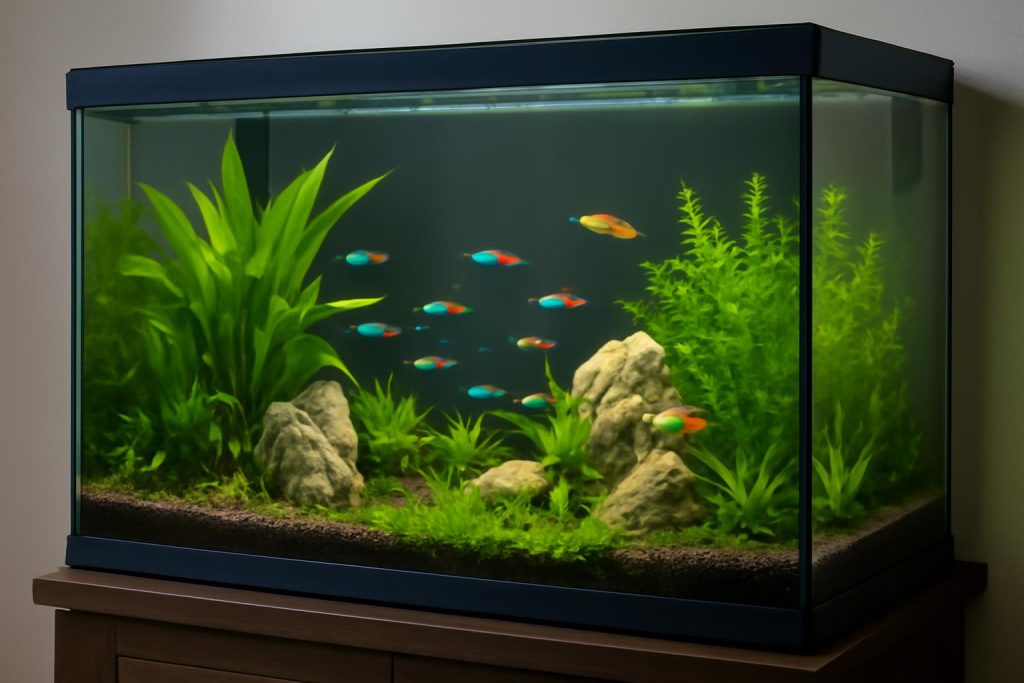
For many beginners, a medium-sized freshwater aquarium offers a practical balance. A tank in the approximate 75- to bre>150-litre range can provide more stable conditions than a very small nano aquarium while remaining manageable in an apartment, condo, or family home.
Choose the aquarium according to the adult size and behaviour of the fish, not the size of juveniles at the store. Schooling fish need swimming length, bottom-dwelling species need floor space, and territorial fish require visual barriers and defined areas.
Consider the room before buying the tank
In Canada, indoor placement is especially important during winter. Avoid positioning an aquarium directly beside a drafty exterior door, uninsulated window, radiator, fireplace, or heating vent. Rapid temperature changes can stress fish and make heaters work harder.
The stand must also be designed for the aquarium’s filled weight. Water alone weighs approximately one kilogram per litre, before adding glass, substrate, rocks, wood, and equipment. A properly levelled aquarium stand is essential for safety and for reducing long-term stress on the tank.
Before ordering, measure doorways, stairwells, elevator access, and the final location. A tank that cannot be moved or serviced comfortably can become a maintenance problem later.
Design filtration for stability, not just clarity
Clear water is useful, but visual clarity does not always mean biological stability. The filter must support beneficial bacteria that process toxic ammonia and nitrite, while also removing suspended debris and distributing oxygenated water throughout the aquarium.
When comparing aquarium filters in Canada, look beyond the advertised flow rate. Consider the tank volume, fish load, available media space, noise level, replacement parts, and ease of cleaning. A filter that is slightly oversized and adjustable can provide useful capacity as fish grow.
Use the right types of filter media
A dependable filtration system normally combines three functions:
- Mechanical media: captures particles such as uneaten food and waste.
- Biological media: provides surface area for beneficial bacteria.
- Chemical media: targets specific dissolved substances when needed.
Do not replace all filter media at once. Doing so can remove much of the established biological population and create an avoidable cycle disruption. Rinse reusable media in removed aquarium water rather than untreated tap water, and replace media only when it has physically deteriorated or the manufacturer recommends it.
Canadian Aquarist’s aquarium product categories provide a useful starting point for comparing filtration equipment and related aquarium accessories.
Choose equipment that can be maintained
Durability matters, but serviceability matters just as much. The best long-term equipment is equipment you can inspect, clean, repair, and replace without dismantling the entire aquarium.
Look for accessible filter components, standard-sized tubing, dependable electrical connections, and replacement parts that are reasonably available in Canada. A low-cost device that becomes impossible to service may cost more over its useful life than a better-supported product.
Heaters and temperature control
Tropical fish generally require stable warm water, even when the room feels comfortable to people. Select a heater appropriate for the tank volume and use a separate thermometer to verify performance. An adjustable heater with an accurate temperature controller can provide more control than a basic preset model.
In colder regions, monitor indoor temperature near the aquarium during winter. A heater should not be expected to compensate for a tank placed beside a cold window. Conversely, direct sun and nearby heating vents can cause unwanted temperature swings in any season.
Lighting for fish and plants
Aquarium lighting should match the purpose of the aquarium. Fish-only tanks generally need a reliable day-and-night schedule, while planted aquariums require light intensity and duration suited to the plant species.
Use a timer rather than relying on memory. A consistent photoperiod helps fish follow a predictable routine and reduces the chance of leaving lights on long enough to encourage excessive algae. For planted aquariums, increase lighting gradually and balance it with plant growth, nutrients, and carbon availability.
Build a substrate and aquascape that can mature
Substrate is more than a decorative layer. It affects plant anchoring, cleaning, water movement, and the appearance of accumulated waste. Choose it according to the aquarium’s livestock and maintenance style.
In a planted aquarium, a nutrient-rich planted tank substrate may support root-feeding species, while inert gravel or sand can work well when nutrients are supplied through the water column. Fine sand can be attractive but should not be packed into a deep, compacted layer without a clear plan for circulation and maintenance.
Hardscape materials such as aquarium rocks and driftwood should be cleaned, inspected, and positioned securely. Avoid unstable structures that could collapse against the glass or trap fish. Leave enough open space to reach the substrate, remove dead leaves, and clean the front panel.
Long-term aquascapes are designed with plant growth in mind. A small plant may eventually shade its neighbours, cover filter intakes, or block swimming space. Leave room for pruning and choose species that match the available light and your willingness to maintain them.
Stock for the adult aquarium, not the shopping day
Overstocking is one of the most common causes of long-term aquarium problems. Fish produce waste, compete for space, and may become aggressive as they mature. A tank that looks understocked in a store can become crowded in a home within months.
Research each species’ adult size, social requirements, temperature range, diet, activity level, and compatibility. Some fish need groups, some need territories, and others are unsuitable for community aquariums altogether.
Add livestock gradually after the aquarium has completed its nitrogen cycle. Introducing too many fish at once can overwhelm the biological filter. New fish should be observed closely, and a separate quarantine aquarium is valuable when space and resources allow.
Feed conservatively
Overfeeding creates waste faster than filtration can process it. Offer only what fish can consume promptly, remove uneaten food when necessary, and vary the diet according to the species. Healthy fish should be active and maintain appropriate body condition rather than appearing constantly swollen or lethargic.
Create a maintenance routine that survives Canadian seasons
Consistency is more valuable than occasional intensive cleaning. A practical routine might include:
- Daily: observe fish, check temperature, and confirm equipment is operating.
- Weekly: inspect water parameters, remove visible debris, and complete a partial water change as needed.
- Monthly: inspect tubing, filter flow, heater condition, lighting, and livestock growth.
- Seasonally: review room temperature, evaporation, plant growth, and equipment cables.
Water changes should be based on stocking, feeding, plant growth, and test results rather than an inflexible percentage. Always treat replacement water appropriately and match its temperature closely to the aquarium.
During winter, allow replacement water to reach a suitable temperature before adding it. Do not place cold water directly into a tropical aquarium. Also check that water conditioners remain stored according to their labels and are not exposed to freezing temperatures during delivery or storage.
For replacement media, decor, tools, and other components, the Canadian Aquarist product catalogue can help you plan maintenance purchases before an essential item fails.
Keep electrical and water safety in focus
Every indoor aquarium combines water and electricity, so setup quality is a safety issue. Use a properly rated power bar or circuit, create drip loops in electrical cords, and keep plugs elevated where possible. Inspect cords for damage and unplug equipment before placing hands in the aquarium.
Do not overload outlets with heaters, lights, filters, air pumps, and unrelated household devices. If you are uncertain about electrical capacity or GFCI protection, consult a qualified electrician.
Keep the aquarium level, inspect seams and fittings, and respond quickly to unexplained moisture. A small leak or loose connection can become a significant home repair during an unattended period.
Use records to improve long-term results
A simple aquarium log can reveal patterns that are easy to miss. Record water test results, water changes, filter cleaning, new livestock, plant additions, medication, and unusual behaviour.
Over time, these notes can show whether nitrate rises before maintenance, whether a heater struggles during cold weather, or whether algae appears after lighting changes. Good records turn aquarium care from guesswork into informed management.
Frequently asked questions
What is the best aquarium size for long-term stability in Canada?
There is no single best size, but a medium aquarium is often more forgiving than a very small tank. Choose the largest aquarium that fits your budget, floor space, stand, and maintenance ability, then stock it responsibly.
How often should aquarium filter media be replaced?
Replace media when it is worn, collapsing, or no longer usable, rather than automatically replacing everything on a fixed schedule. Rinse reusable media in removed aquarium water and avoid replacing all biological media at once.
Can an indoor aquarium be placed near a window?
It can, but direct sunlight may cause algae and temperature fluctuations. Keep the tank away from drafts and intense sun, particularly during Canadian winter and summer temperature extremes.
Are planted aquariums easier to maintain over time?
A well-planned planted aquarium can help absorb nutrients and provide shelter, but plants also require appropriate lighting, pruning, and nutrition. Choose low-demand species if you want a simpler system.
Where can I find aquarium equipment in Canada?
Canadian aquarists can browse the Canadian Aquarist online aquarium store for equipment, filtration products, aquarium decor, plants, fish, and other supplies. Review product specifications carefully to match each item to your aquarium.
Plan for the aquarium you want to keep
The strongest foundation for aquarium longevity in Canada is realistic planning. Select a tank that suits the room, use dependable equipment, stock for adult fish size, and build a maintenance routine that fits your life.
An indoor aquarium should become easier to manage as it matures, not more chaotic. By designing for stability from the beginning, you give fish a healthier environment and give yourself a more enjoyable display that can thrive through many Canadian seasons.
